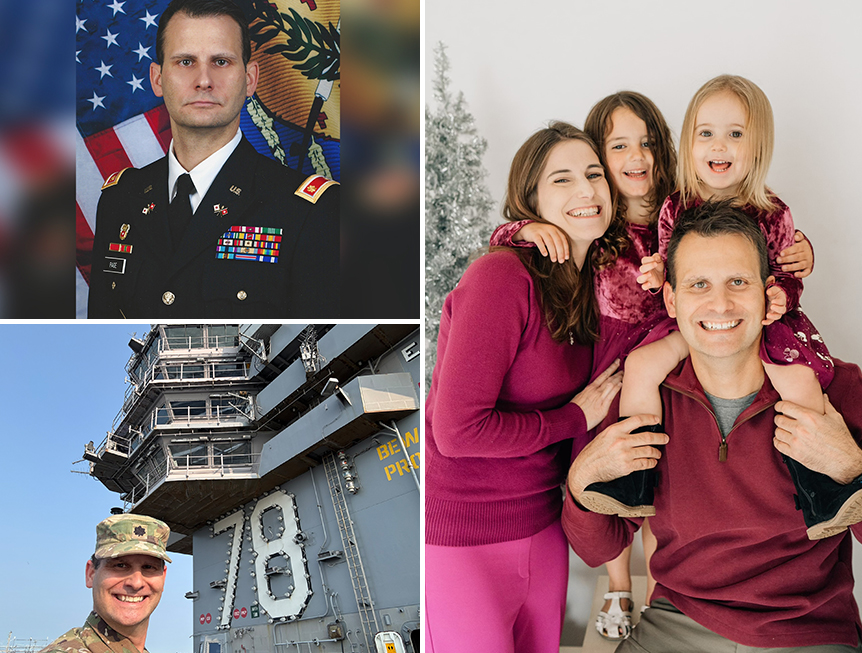
Josh Page joined the National Guard in college and continues his military service today. He balances this service with his IT responsibilities at Expand Energy, which he joined as an intern in 2011. He was drawn to our company’s relentless focus on safety, training and preparedness (what he calls ‘confident resilience’) and the speed of execution that has made Expand Energy a leader.
We celebrate Josh this Veterans Day and recognize the courage and sacrifice of all who have served.
What inspired you to serve in the Oklahoma Army National Guard — and what’s kept you committed for over 25 years?
Inspired might be a little strong, my best friend in college joined the National Guard our sophomore year of college after losing his financial aid. I have a bad tendency to trash talk those I like the most, which I did, and I also have a weakness to the double dog dare. So, I was challenged to back up my speech, and I ended up enlisting with him as an infantryman in the Oklahoma National Guard.
We chose infantry because it was one of the few jobs that could be completed in the summer between college semesters. While trash talking and bravado got me in the door, I think there was something about being out on my own for the first time, being really challenged and seeing what I could accomplish that I needed to do.
I also strongly believe that if you can serve others, you should. Being ready in the event my community, state or country needs me is something that keeps me committed.
What is a common misconception about the Oklahoma Army National Guard?
The National Guard (both Army and Air) attends the same qualifying courses and has to maintain the same standards and certifications as their active-duty counterparts. The difference is we only have about 40 training days each year to maintain proficiency.
Also, in addition to being available for federal missions, we are available to the Governor for whatever missions he needs — for Oklahoma that commonly includes responding to hurricanes (for our Gulf Coast neighbors), tornado, drought, wildfire, floods and winter storms.
You’ve held leadership roles in some high-pressure environments, including overseas deployment and Hurricane Katrina relief efforts. What did those experiences teach you and how do you carry those lessons into your work today?
I think there’s a few lessons I carry close. First, operating like a marathon versus a sprint. Deployments are long — often 9 to 15 months. Leadership sets the tempo of deployment and that operational tempo can make an enormous difference in the overall success. On my first deployment, the leadership team treated every day as a sprint, demanding maximum effort, maximum vigilance, every day. Which meant when we actually needed to sprint, the tank was empty and our response suffered. My second deployment was handled much more like a marathon, and the results were night and day. Being able to recognize those critical moments when sprinting is needed, marshaling that extra effort and deploying it to maximum effect is an art of leadership.
Second, the importance of timing. By nature, I’m task / action oriented. Once there’s consensus for action, I want to act. I have had to learn that just because you’ve identified the right action, and know that it’s necessary, doesn’t mean it’s the right moment to act on it. Like in football when a running back stutters or slow steps to give the linemen time to open a lane, I am learning to think a lot about timing and clearing lanes to enable my team to perform.
The last thing is the commander’s intent, which is critical because it articulates the desired end state — what the leader personally sees as winning. I believe that if there is broad understanding of the why, it empowers initiative. I always try to articulate the outcome I want, why it’s important, and if I’m lucky, it helps develop others to also think in terms of outcomes, not just tasks.
What values from your military career continue to guide you in your civilian career?
The military loves to make acronyms out of everything, so of course the Army core values are LDRSHIP, which stands for Loyalty, Duty, Respect, Selfless Service, Honor, Integrity and Personal Courage. The last two, Integrity and Personal Courage are ones that I try to show up for every day.
I’ve made the same ‘deal’ with every leader I’ve worked for — I’ll provide unfiltered honest feedback when developing the course of action and then execute to the best of my ability whatever course is chosen. I’ve been lucky in my civilian and military careers that the majority of the leaders I’ve worked for have been collaborative and focused on seeking the best outcome.
What does Veterans Day mean to you personally?
For me it’s an opportunity to reflect, celebrate and be grateful for the benefits serving has brought me and my family. It’s also an opportunity to reconnect with military friends and swap stories.
Only 6 to 7% of the U.S. population has served, and only 0.4% of the U.S. population serves on active duty. That means that so much rests on so few. The last few years, especially as the Global War on Terrorism has ended, I also find myself answering more questions, telling stories and experiences to the curious.
What do you like to do for fun (outside of work and your military service)?
I have two daughters, Alara (7) and Caira (4) who are the majority of my fun!
A lot of my hobbies tend to be tech related — video games, gadgets, Legos — stereotypical IT nerd things! I’m also a very avid reader, and I like to ride an old 2008 Harley Nightster I got after my first deployment.